7-8 May
I was picked up at my hotel shortly after 6.30am for my 2-day tour from Istanbul to Selcuk via Gallipoli, Canakkale, Troy and Pergamum. It turned out that there were only 3 others the bus picked up that morning – a man from China who was going straight through to Troy, and a couple form Marton - Jill and Tom Willis, who knew my parents in law, Howard and Joan Jones. I really enjoyed talking with them on the journey to Gallipoli, which was a 4-5 hour bus ride. Along the way, I realised that Tom and Jill were going back to Istanbul that night – and with the Chinese man going straight to Troy, I was the only one on my 2-day guided tour. (More of this later!)
After a nice lunch in Eceabat, we went on to Gallipoli. One of the first things we did was to visit the museum. I was particularly struck by a display of bullets that had been struck by other bullets – indicating the intensity of the gunfire with a hail of bullets coming from both sides. For some peculiar reason I didn’t take a photo of them! So here is a file photo from the internet (much lower resolution than mine I'm sorry to say).
My attention was also caught by a letter that one soldier had written to his family, saying that no one had been killed and only 3 people had been wounded in the withdrawal from Gallipoli in December, 1915. My grandfather Onslow, who died when I was around 18 months old, apparently used to say that he was one of the last people wounded on Gallipoli. He was riding on a gun carriage that was being taken off shore, when he was shot in the leg. So he was probably one of those 3 soldiers recorded as being wounded in the withdrawal.
Next, we drove down past Brighton Beach to ANZAC cove. It was noticeably steep just up from ANZAC cove, whereas Brighton Beach, where the troops were supposed to land, led to a low-lying plain and easier access to the summit of the mountain overlooking the peninsula. The reason they landed in the wrong place was apparently because the marker they were using to mark the landing spot washed down the coast in a storm before the date of the landing! That seems to have been typical of the shoddy planning of this campaign.
From there we went to the Lone Pine Memorial, which is particularly focused on the Australian forces. The next stop was to look at the closeness of the trenches at one point just next to the modern road to the top of the ridge. The Turkish and allied trenches at this point were no more than 8 metres distant from one another!
Next we stopped at the 57th regiment Turkish memorial (in Turkey the 57th regiment became famous because of the self-sacrifice shown by its soldiers. Not one man from the regiment survived the Turkish defence of Gallipoli). Mustafa Kemal Ataturk, who appears on statues and posters throughout Turkey, is acknowledged as the father of the modern state. He was the first Turkish Prime Minister in the 1920s and was significant in the Gallipoli campaign as the Turkish officer commanding the defending troops (a German officer in overall command of the defence entrusted it to Kemal). Not only did he have great military ability, he had a remarkable ability to give words and meaning to the sacrifice that was being made by the Turkish troops. On the 57th regiment memorial, you can read the following words:
To the allied soldiers who died in the Gallipoli campaign and to their mothers, Ataturk wrote, “Those heroes that shed their blood and lost their lives…you are now lying in the soil of a friendly country. Therefore rest in peace. There is no difference between the Johnnies and the Mehmets to us where they lie side by side here in this country of ours. You, the mothers who sent your sons from far away countries, wipe away your tears. Your sons are now lying in our bosom and are at peace. After having lost their lives in this land, they have become our sons as well.”
From my brief time in Turkey I got the impression that Ataturk was one of the truly great leaders of the 20th century, not only successfully defending his country against various military incursions, but also reforming it and making it into a modern state. I look forward to reading more about him when I return to New Zealand.
Finally, we went up to the top of the hill to visit Chunuk Bair. When English and French troops landed at Souvla Bay, some distance away from this high point, after the first Gallipoli landing, the Turks concentrated their defence against them. (Here you can see Souvla Bay in the distance.)
While they were doing this, some New Zealand and Gurkha troops came up behind them and took Chunuk Bair, the highest point and chief objective of all the fighting in the Gallipoli campaign. The strategic view was that those who held Chunuk Bair would hold the peninsula. But the Turkish troops rallied and attacked time and again, so that without reinforcements the troops that had taken the position were in real difficulty. They held out for one day, and then on the second day they were pushed back by the Turkish soldiers – and the allied advance on the Gallipoli peninsula was effectively over. The stalemate that resulted led eventually to the withdrawal of the allied troops.
All of the above left me with feelings of sadness about the pointlessness of the campaign, admiration for Kemal Ataturk and the Turkish soldiers, admiration too for the bravery of the allied soldiers, dismay about some of the terrible decisions made by the allied commanders, all mixed in with a sense that this was an important visit to make – both as a New Zealander, and as the grandson of a veteran of the campaign.
After this visit I was taken to Eceabat and was handed a ticket for the ferry to Canakkale. The tour company obviously thought that doing a whole tour for one person was uneconomic, so without discussing it with me, they had decided that I would travel on public transport and have company personnel meet me at various points. The only trouble was that at some points they failed to meet me or to provide things that had clearly been part of the tour they had promised me. It was actually a bit of a comedy of errors, and not a disaster because I got to my destinations, but it was odd to have decisions made about changes to my tour without being consulted.
In naïve expectation that someone would be waiting to meet me off the ferry, I took the ferry to Canakkale. But after having waited for 20 minutes or so outside the ferry terminal I asked someone for directions to my hotel, the name of which I had been told, and the person kindly walked me over to it. It was 3 minutes walk away! The hotel was the nicest one I had stayed at so far – a boutique hotel in an old Turkish house. I thoroughly enjoyed it.
That night I watched the Mel Gibson Gallipoli film, had dinner and did some planning for my visit to Patmos. The next morning I was getting concerned when my guide for my Troy tour did not turn up at the right time, so the hotel receptionist kindly phoned the tour company and the guide arrived a few minutes later.
People had said that there was not much to see at Troy, but in fact my visit to Troy was one of the highlights of my trip so far. I had a personal guided tour, and the guide did a great job of explaining the site to me. I will not bore you with a lengthy description of his explanations, and the site itself does not have many grand monuments to show, but there is good evidence of the various stages of walls on the Troy ‘tell’ or mound.
Heinrich Schliemann was famously the first person to excavate Troy, in the 19th century. Archaeology was only in its infancy, and although Schliemann in some ways was ahead of his time, his basic approach was to look for the “treasure of Priam” that he thought was buried somewhere on the site. So he dug a trench that was rather like a bulldozer trench straight through the tell, obliterating virtually everything in its way, and destroying a lot of evidence in the process.
Eventually Schliemann did find some treasure and spirited it out of the country, contrary to an agreement he had with the Turkish government of the time!
The various ‘layers’ or ‘levels’ of the city are noted in the above picture. Scholars differ as to whether the Troy that was destroyed by the Greeks was the 6th or 7th level, with most scholars considering that the city that was destroyed was level 7B. Apparently the walls of this level were once around 22 feet high. Here are some remains from this wall.
Note the stones that have been specially chiselled to allow other stones to inter-lock with them (you can see 2 examples at the top left), thereby making the wall stronger.
The outlook from the tell gave a clear reason why Troy became a major city. It was within sight of the Hellespont, and therefore presided over important trade routes between Asia and Europe. The following picture shows the sea quite far away, but in ancient times it was much closer to the city.
Having studied both the Iliad and the Odyssey of Homer when I took ancient Greek at university, it was a real pleasure to see Troy and to have the site interpreted for me.
After the tour, I was taken back to Canakkale to get a bus to Bergama (Pergamum) which was my next stop. Unfortunately I just missed the bus, and taking the next bus and going by public transport meant that I reached Pergamum shortly before 5pm. The person who met me off the bus was not a guide and told me that the Pergamum site closed at 6pm, so we raced up the hill and I took a quick look around this impressive site before connecting with my driver and being taken back to the bus.
(This is the Sanctuary of Trajan, built in the second century AD).
I was put on a bus to Izmir, and from there needed to transfer to a bus to Selcuk, where I was going to stay close to the ancient city of Ephesus. As I had missed out on both the guided tour of Pergamum and the lunch that had been a specified part of my tour, I contacted the tour company by mobile phone from the bus, to try and reach some alternative arrangement. I agreed with the company that I would get a guided tour and lunch for my planned Ephesus trip tomorrow, which I had been going to do independently. The bus conductor kindly guided me from the Izmir bus to the bus to Selcuk. and I got to my hotel around 10pm. The Nazar Hotel was a very nice budget hotel, and I was glad to be there, especially after the uncertainties of my travel that day.
18 May 2010
17 May 2010
Istanbul
4-6 May
As the Istanbul metro was not working when I arrived, and the train station was not far from the Sultanahmet area in which my hotel was, I walked up the hill to Sultanahmet. There is a lot of tourist accommodation in Sultanahmet, because so many of the key sites are in this area – the great cathedral of Hagia Sophia, which was converted into a mosque and is now a museum, the Basilica Cistern, the Blue Mosque, the hippodrome and the Topkapi Palace, to name just the main ones.
I got to the hotel after asking for directions a few times, and was given a hospitable welcome and a very adequate room with a double bed. Luxury! I decided that I would take the day fairly easily, so I did a few chores, spent some time on the computer, and then had a sleep. In the evening I had arranged to have dinner with Nancy Woodburn, a course member from the Bible and its Setting course, and her daughter Anna, who were in Turkey. This was their final night in the country. We had a lovely evening and a delicious meal together.
The next day I set off early for Hagia Sophia, the cathedral of Constantinople during the time of the Roman Empire in the East, until Constantinople was captured by the Turks and it was turned into a mosque (hence the four minarets). This Church was built by the Emperor Justinian in the sixth century AD, and for 1,000 years was the largest building in the world.
It is an awesome and remarkable building, with the beautiful dome sitting majestically above it. In fact, with the windows shedding light into the dome, the dome almost seems to hover over the building rather than to weigh down upon it.
Apparently it was the flexible resin in the mortar between the stones that has kept the dome intact through countless earthquakes over 15 centuries.
When Constantinople was taken by the Turks in 1452, they immediately converted Hagia Sophia into a mosque. But in 1932, on the recommendation of Kemal Ataturk, it ceased to be a place of worship and was officially designated as a museum, thereby making it more accessible to Christians. Elements sacred to both Muslim and Christian worshippers have been retained.
In the photo above you can see quotations from the Qur’an in Arabic script and the mihrab (niche that points to Mecca) in the apse – the former Christian sanctuary. Just under the dome you can also see depictions of the six-winged seraphs (in one of these the face has now been revealed - it was formerly plastered over in keeping with Islamic prohibitions on the depiction of creatures).
The Turks are now renovating the building, and more and more of the Christian elements that had been painted or plastered over are being revealed. Chief among these are some beautiful mosaics. From the left, this mosaic depicts the Virgin Mary (Theotokos), Jesus Christ, and John the Baptist (the Forerunner).
The beauty of these mosaics can be seen even more clearly ‘close up’.
After a break I went to the underground ‘Basilica Cistern’, which despite the name is not particularly associated with Hagia Sophia. It was built in the reign of Justinian to hold water for the city, and to store it in case of siege or drought. The water was brought by aqueduct to the city from a water source 19kms away. The cistern is huge – 140 metres long by 70 metres wide, thus covering a total area of 9,800 square metres. The 336 marble columns of the cistern are 9 metres high.
The cistern is partially lit so that people can get some idea of its size.
Following this visit I headed off to the Blue Mosque, which had been built in the 15th century AD, after the capture of Constantinople. This was a beautiful building with amazing tile work and lovely stained glass windows.
I made my way home via the old Constantinople hippodrome. This has been converted into a promenade, but still retains a few important monuments from imperial times. The first one is partly broken, but highly significant for anyone like me who has studied classical Greek. It is a column formed by 3 intertwined bronze serpents and dedicated to Apollo by the 31 city states who defeated the Persians in the battle of Plataea in 480BC. This victory was an incredibly important ‘coming of age’ for the ancient Greeks. It brought in the great flowering of the classical period in Athens, with its buildings, sculpture and art, drama, poetry, historical and other writing, and so on. I was amazed to see the monument, because I didn’t know that it still existed.
The second monument is an obelisk from the time of Egyptian Pharoah Tuthmose III (1479-1426BC). It was brought to Constantinople in the reign of Theodosius in the late fourth century and erected in this place, but it is in such a fine state of preservation that it looks as if it was sculpted in the last few years.
After all this sightseeing, it was time for a break, so I took it easy for the rest of the day.
The next day I was up early again for a day of museum visiting. I headed off for the Topkapi Palace, which had been the residence of the Turkish Sultans, along with their harem and entourage.
The Palace was magnificent, with beautiful buildings, and outstanding collections of jewellery and other precious things. Again, a few photos will have to suffice to give you some idea. No photos were allowed in the Treasury areas, so if you are interested, take a look on Google for some of the treasures of the Topkapi palace. They are amazing!
I went first to the harem and private rooms of the Sultan. The rooms of the Queen Mother in the harem were very impressive. The Ottoman decoration is from the 17th century and the Western influences are from the 19th century.
The Imperial Hall served both as the Sultan’s official reception area and as the entertainment hall for the harem.
The private rooms of Sultan Murad III, built by the famous architect Sinan in 1578, are considered among the finest examples of Ottoman architecture.
The apartments of the Crown Prince were also gorgeous, with the beautiful stained glass windows being complemented by matching tiles.
and so it went on. One room surpassed another in beauty, and one treasure outshone the previous one in opulence. There was also a magnificent view over the Bosphorus from the palace.
Along with the huge number of Topkapi treasures, there was a beautiful visiting exhibition on display – 5,000 years of Japanese Art. No photos were allowed at this exhibition, but very memorable amongst the items in the Japanese collection were two beautiful early Buddhist statues (one of lacquered wood, one of stone) depicting human figures in an attitude of prayer. They communicated in a wonderful way a spirit of serenity and inner peace.
After the Topkapi Palace I went to the Archaeology Museums close by. I had been told that they were good, but I was not prepared for how wonderful they were. They were amazing – with exhibitions of beautiful sarcophagi, grave stones and artefacts from Greek, Hittite and other Anatolian civilisations, exhibitions from Egypt, Cyprus, Troy, the Byzantine Empire, and so on. Unfortunately my camera battery ran out along the way, so some of the most impressive ancient Anatolian and Egyptian items I didn’t record.
The exhibitions started with sarcophagi from a royal necropolis (cemetery) in Sidon (modern Lebanon) found in the late 19th century. This sarcophagus dates from the 4th century BC.
Here is some of it as it would have looked before the original paint peeled off.
There were many grand and beautiful sarcophagi, but also more touching and personal monuments to the dead. I thought the following wording was moving: “Philippos has erected this stele for his wife Tryphaine, who was his heart’s content.” And another stele caught my attention too.
It reads, “His owner has buried the dog Parthenope that he played with, in gratitude for this happiness. [Mutual] love is rewarding, like the one for this dog. Having been a friend to my owner, I have deserved this grave.”
The exhibitions certainly weren’t by any means all focused on death. This beautiful pottery was made in Cyprus between 1050 and 750BC.
As the Istanbul metro was not working when I arrived, and the train station was not far from the Sultanahmet area in which my hotel was, I walked up the hill to Sultanahmet. There is a lot of tourist accommodation in Sultanahmet, because so many of the key sites are in this area – the great cathedral of Hagia Sophia, which was converted into a mosque and is now a museum, the Basilica Cistern, the Blue Mosque, the hippodrome and the Topkapi Palace, to name just the main ones.
I got to the hotel after asking for directions a few times, and was given a hospitable welcome and a very adequate room with a double bed. Luxury! I decided that I would take the day fairly easily, so I did a few chores, spent some time on the computer, and then had a sleep. In the evening I had arranged to have dinner with Nancy Woodburn, a course member from the Bible and its Setting course, and her daughter Anna, who were in Turkey. This was their final night in the country. We had a lovely evening and a delicious meal together.
The next day I set off early for Hagia Sophia, the cathedral of Constantinople during the time of the Roman Empire in the East, until Constantinople was captured by the Turks and it was turned into a mosque (hence the four minarets). This Church was built by the Emperor Justinian in the sixth century AD, and for 1,000 years was the largest building in the world.
It is an awesome and remarkable building, with the beautiful dome sitting majestically above it. In fact, with the windows shedding light into the dome, the dome almost seems to hover over the building rather than to weigh down upon it.
Apparently it was the flexible resin in the mortar between the stones that has kept the dome intact through countless earthquakes over 15 centuries.
When Constantinople was taken by the Turks in 1452, they immediately converted Hagia Sophia into a mosque. But in 1932, on the recommendation of Kemal Ataturk, it ceased to be a place of worship and was officially designated as a museum, thereby making it more accessible to Christians. Elements sacred to both Muslim and Christian worshippers have been retained.
In the photo above you can see quotations from the Qur’an in Arabic script and the mihrab (niche that points to Mecca) in the apse – the former Christian sanctuary. Just under the dome you can also see depictions of the six-winged seraphs (in one of these the face has now been revealed - it was formerly plastered over in keeping with Islamic prohibitions on the depiction of creatures).
The Turks are now renovating the building, and more and more of the Christian elements that had been painted or plastered over are being revealed. Chief among these are some beautiful mosaics. From the left, this mosaic depicts the Virgin Mary (Theotokos), Jesus Christ, and John the Baptist (the Forerunner).
The beauty of these mosaics can be seen even more clearly ‘close up’.
And I thought the expression on the face of John the Forerunner (John the Baptist) was particularly beautiful.
It is probably revealingly partisan of me, but I have something to admit here. While acknowledging the generous spirit of Ataturk in converting this from a mosque to a museum, and while greatly enjoying my visit to Hagia Sophia, I still felt a pang of sadness that this majestic expression of Christian faith had been put to other uses than the purpose of Christian worship for which it was originally intended.
After a break I went to the underground ‘Basilica Cistern’, which despite the name is not particularly associated with Hagia Sophia. It was built in the reign of Justinian to hold water for the city, and to store it in case of siege or drought. The water was brought by aqueduct to the city from a water source 19kms away. The cistern is huge – 140 metres long by 70 metres wide, thus covering a total area of 9,800 square metres. The 336 marble columns of the cistern are 9 metres high.
The cistern is partially lit so that people can get some idea of its size.
Following this visit I headed off to the Blue Mosque, which had been built in the 15th century AD, after the capture of Constantinople. This was a beautiful building with amazing tile work and lovely stained glass windows.
I made my way home via the old Constantinople hippodrome. This has been converted into a promenade, but still retains a few important monuments from imperial times. The first one is partly broken, but highly significant for anyone like me who has studied classical Greek. It is a column formed by 3 intertwined bronze serpents and dedicated to Apollo by the 31 city states who defeated the Persians in the battle of Plataea in 480BC. This victory was an incredibly important ‘coming of age’ for the ancient Greeks. It brought in the great flowering of the classical period in Athens, with its buildings, sculpture and art, drama, poetry, historical and other writing, and so on. I was amazed to see the monument, because I didn’t know that it still existed.
The second monument is an obelisk from the time of Egyptian Pharoah Tuthmose III (1479-1426BC). It was brought to Constantinople in the reign of Theodosius in the late fourth century and erected in this place, but it is in such a fine state of preservation that it looks as if it was sculpted in the last few years.
After all this sightseeing, it was time for a break, so I took it easy for the rest of the day.
The next day I was up early again for a day of museum visiting. I headed off for the Topkapi Palace, which had been the residence of the Turkish Sultans, along with their harem and entourage.
The Palace was magnificent, with beautiful buildings, and outstanding collections of jewellery and other precious things. Again, a few photos will have to suffice to give you some idea. No photos were allowed in the Treasury areas, so if you are interested, take a look on Google for some of the treasures of the Topkapi palace. They are amazing!
I went first to the harem and private rooms of the Sultan. The rooms of the Queen Mother in the harem were very impressive. The Ottoman decoration is from the 17th century and the Western influences are from the 19th century.
The Imperial Hall served both as the Sultan’s official reception area and as the entertainment hall for the harem.
The private rooms of Sultan Murad III, built by the famous architect Sinan in 1578, are considered among the finest examples of Ottoman architecture.
The apartments of the Crown Prince were also gorgeous, with the beautiful stained glass windows being complemented by matching tiles.
and so it went on. One room surpassed another in beauty, and one treasure outshone the previous one in opulence. There was also a magnificent view over the Bosphorus from the palace.
Along with the huge number of Topkapi treasures, there was a beautiful visiting exhibition on display – 5,000 years of Japanese Art. No photos were allowed at this exhibition, but very memorable amongst the items in the Japanese collection were two beautiful early Buddhist statues (one of lacquered wood, one of stone) depicting human figures in an attitude of prayer. They communicated in a wonderful way a spirit of serenity and inner peace.
After the Topkapi Palace I went to the Archaeology Museums close by. I had been told that they were good, but I was not prepared for how wonderful they were. They were amazing – with exhibitions of beautiful sarcophagi, grave stones and artefacts from Greek, Hittite and other Anatolian civilisations, exhibitions from Egypt, Cyprus, Troy, the Byzantine Empire, and so on. Unfortunately my camera battery ran out along the way, so some of the most impressive ancient Anatolian and Egyptian items I didn’t record.
The exhibitions started with sarcophagi from a royal necropolis (cemetery) in Sidon (modern Lebanon) found in the late 19th century. This sarcophagus dates from the 4th century BC.
Here is some of it as it would have looked before the original paint peeled off.
There were many grand and beautiful sarcophagi, but also more touching and personal monuments to the dead. I thought the following wording was moving: “Philippos has erected this stele for his wife Tryphaine, who was his heart’s content.” And another stele caught my attention too.
It reads, “His owner has buried the dog Parthenope that he played with, in gratitude for this happiness. [Mutual] love is rewarding, like the one for this dog. Having been a friend to my owner, I have deserved this grave.”
The exhibitions certainly weren’t by any means all focused on death. This beautiful pottery was made in Cyprus between 1050 and 750BC.
And there were other remarkable exhibits. I took almost 8 hours looking at the exhibitions at the Topkapi Museum and Archaeology Museums, and if I had had an extra day in Istanbul I might even have gone back to the Archaeology Museums to photograph more of the Sumerian, Assyrian and Egyptian a
rtefacts. If you get the chance to go, don’t miss them – and take a spare camera battery!Xenophontos Monastery and Onwards
2-4 May
I took a few photos of the little port village of Dafni, bought my ticket at the Customs and ticket office, and waited.
As I sat, I smiled at an old Greek man who had come in the same bus with me from Simonos Petras. He smiled back, and as he passed he patted my head. I have had a lot of kindness from men of all ages on this trip. It has been very interesting being in a ‘men only’ zone. The sense of brotherhood has been strong. Here there are well over 1,000 – perhaps even 2,000 – men all seeking to deepen their relationship with God.
The ferry came at the expected time, and before long I stepped out on the wharf of Xenofontos monastery. I watched the ferry leave,
and then walked along to the monastery gate.
As I entered I noticed a sign saying that people were asked not to come during the week of 2-8 May as the monks were preparing for a Patronal feast day. Oops! That would explain why only 4 people got off the ferry. Still I had received a fax saying that I was welcome, so I continued on up the stairs and went into the guest house.
I was greeted by a monk who did not speak much English. He showed me to my room and gave me a rough idea of the programme of the monastery. The few other guests did not speak English either, so it was clear that I was going to be doing my own thing pretty much during this time. I decided that I would take a walk along the beach. I took a photo looking back towards the monastery. My room was in the building further away, where the 5th and 6th windows from the right are, just where the building extends out above the wall.
I also took a photo of the sea, as it reminded me of words from the classical Greek poet Aeschylus’ play, ‘The Persians’, where he speaks of ‘the limitless laughter of the sea’ (anarithmon pontou gelasmon).
I went to the service at 5pm and then on to dinner. After dinner I heard someone speaking in English. The speaker was a Canadian man, who was a retired professor of medieval art history and who had been coming to the Holy Mountain for 25 years. He was well known to the monks at Xenophontos monastery and was staying for 7 weeks. We had quite a long chat and it was interesting to meet him and to hear what he had to say. Then I watched a beautiful sunset from the guest house balcony.
The next day I attended the morning services and had breakfast. After that I took some photos within the monastery, as this was permitted. I took the next two photos in the early morning light, before the sun was really up. The first is of the central courtyard and the second is of the lower courtyard looking at the monks rooms.
A little later, the sun was shining more brightly, and the garden looked lovely.
You can see from the photos above how beautifully maintained the monastery is.
Early in the afternoon I left the monastery and caught the ferry back to Ouranoupoli, picked up my large suitcase from my hotel, and caught the bus back to Thessaloniki. On the bus was an English man whom I had meet at Simonos Petras. Fr Gregory had been an Anglican priest but was now an Antiochene Orthodox priest, ministering in Manchester, who had been visiting Mt Athos. We had a lovely conversation for the more than 2 hours it took to reach our bus station in Thessaloniki. I then took a bus to the train station, bought a ticket for the overnight train to Istanbul, and waited a few hours for the train.
This wait gave me time to have dinner and also to do some initial processing of my time at Mt Athos. It had been an extraordinary privilege to experience a part of our world that is totally set aside for prayer and the worship of God, and one that is so rich in natural and human-created beauty. Because there were few English speakers where I had gone, I had been pretty much left to my own resources, but that was okay, and besides I wasn’t on my own. I was on pilgrimage – a time of journeying spent consciously in the company of God. If I ever get the chance to go again, I would jump at it, and of the monasteries that I visited, the one that I would most like to return to is Simonos Petras. I experienced this as the high point of my visit to the Holy Mountain not just because it was so arrestingly beautiful, but because of the warmth of the hospitality and the experience I had of connection with Fr Makarios who spoke to me about prayer. All of this helped me to connect both with the place and with God in a very special way.
The train arrived around 7.30pm. There were not many passengers, so I had the sleeping car all to myself. I slept fitfully throughout the train trip, and was awake at aunrise to take photos of the beautiful countryside through which we were travelling.
We got into Istanbul around 9.15am.
I took a few photos of the little port village of Dafni, bought my ticket at the Customs and ticket office, and waited.
As I sat, I smiled at an old Greek man who had come in the same bus with me from Simonos Petras. He smiled back, and as he passed he patted my head. I have had a lot of kindness from men of all ages on this trip. It has been very interesting being in a ‘men only’ zone. The sense of brotherhood has been strong. Here there are well over 1,000 – perhaps even 2,000 – men all seeking to deepen their relationship with God.
The ferry came at the expected time, and before long I stepped out on the wharf of Xenofontos monastery. I watched the ferry leave,
and then walked along to the monastery gate.
As I entered I noticed a sign saying that people were asked not to come during the week of 2-8 May as the monks were preparing for a Patronal feast day. Oops! That would explain why only 4 people got off the ferry. Still I had received a fax saying that I was welcome, so I continued on up the stairs and went into the guest house.
I was greeted by a monk who did not speak much English. He showed me to my room and gave me a rough idea of the programme of the monastery. The few other guests did not speak English either, so it was clear that I was going to be doing my own thing pretty much during this time. I decided that I would take a walk along the beach. I took a photo looking back towards the monastery. My room was in the building further away, where the 5th and 6th windows from the right are, just where the building extends out above the wall.
I also took a photo of the sea, as it reminded me of words from the classical Greek poet Aeschylus’ play, ‘The Persians’, where he speaks of ‘the limitless laughter of the sea’ (anarithmon pontou gelasmon).
I went to the service at 5pm and then on to dinner. After dinner I heard someone speaking in English. The speaker was a Canadian man, who was a retired professor of medieval art history and who had been coming to the Holy Mountain for 25 years. He was well known to the monks at Xenophontos monastery and was staying for 7 weeks. We had quite a long chat and it was interesting to meet him and to hear what he had to say. Then I watched a beautiful sunset from the guest house balcony.
The next day I attended the morning services and had breakfast. After that I took some photos within the monastery, as this was permitted. I took the next two photos in the early morning light, before the sun was really up. The first is of the central courtyard and the second is of the lower courtyard looking at the monks rooms.
A little later, the sun was shining more brightly, and the garden looked lovely.
You can see from the photos above how beautifully maintained the monastery is.
Early in the afternoon I left the monastery and caught the ferry back to Ouranoupoli, picked up my large suitcase from my hotel, and caught the bus back to Thessaloniki. On the bus was an English man whom I had meet at Simonos Petras. Fr Gregory had been an Anglican priest but was now an Antiochene Orthodox priest, ministering in Manchester, who had been visiting Mt Athos. We had a lovely conversation for the more than 2 hours it took to reach our bus station in Thessaloniki. I then took a bus to the train station, bought a ticket for the overnight train to Istanbul, and waited a few hours for the train.
This wait gave me time to have dinner and also to do some initial processing of my time at Mt Athos. It had been an extraordinary privilege to experience a part of our world that is totally set aside for prayer and the worship of God, and one that is so rich in natural and human-created beauty. Because there were few English speakers where I had gone, I had been pretty much left to my own resources, but that was okay, and besides I wasn’t on my own. I was on pilgrimage – a time of journeying spent consciously in the company of God. If I ever get the chance to go again, I would jump at it, and of the monasteries that I visited, the one that I would most like to return to is Simonos Petras. I experienced this as the high point of my visit to the Holy Mountain not just because it was so arrestingly beautiful, but because of the warmth of the hospitality and the experience I had of connection with Fr Makarios who spoke to me about prayer. All of this helped me to connect both with the place and with God in a very special way.
The train arrived around 7.30pm. There were not many passengers, so I had the sleeping car all to myself. I slept fitfully throughout the train trip, and was awake at aunrise to take photos of the beautiful countryside through which we were travelling.
We got into Istanbul around 9.15am.
The Holy Monastery of Simonos Petras
1-2 May, 2010
After prayer and breakfast the next day, I left Vatopedi monastery for the holy monastery of Simonos Petras. This was close to the port of Dafni, so I planned to take a bus to Dafni and a ferry from there. When I got there, because 1 May is a Greek holiday I was not quite sure whether the ferry timetable would run as planned, and I could not find anyone to ask who could tell me the answer in English. So as I had enjoyed my walk from Karyes to Vatopedi, I decided to walk again. This time, instead of going along and down, the road went up and up – and up.
I was pretty tired by the time the road levelled out, but I enjoyed the view.
What I didn’t know is that a bus comes and goes to Simonos Petras monastery and I could have caught that! A bus passed by but it was full! Never mind, despite a few aches, I was really quite happy to walk as it was part of that whole thing of going on pilgrimage. And also I had again that wonderful sense of suddenly seeing my destination. It was truly awe-inspiring.
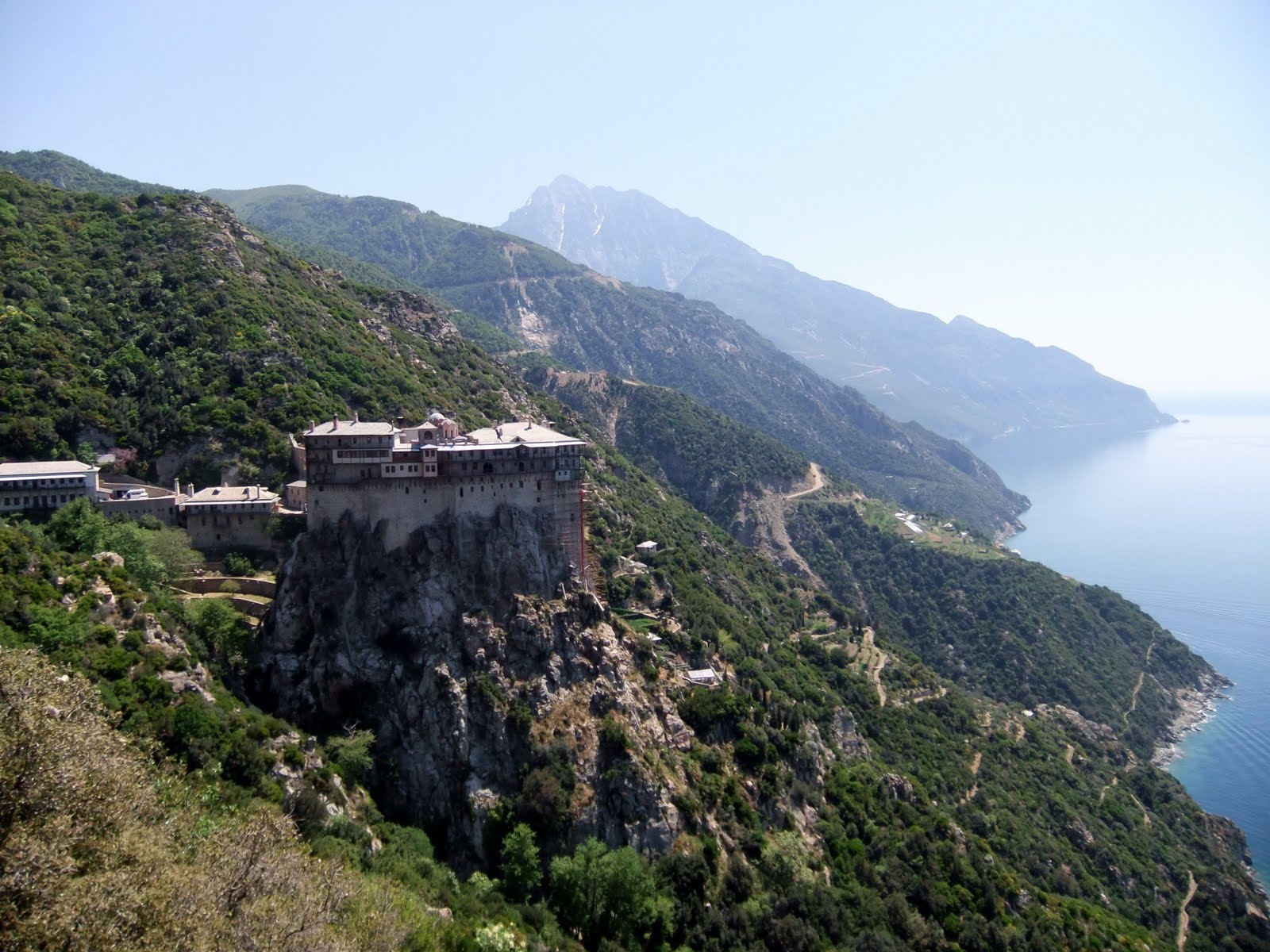
The Holy monastery of Simonos Petra is set 1,000 feet above the water, to give added protection against the pirates and other attackers that used to plague the monasteries of the Holy Mountain.
As I gazed at it I thought that Peter Jackson could hardly have imagined it in a Lord of the Rings film, but this was real. Once again, there was scaffolding here as upgrading work was being done to this monastery. But when I reached the monastery, I found was that much of it was in a beautiful state of repair. It was truly out of this world.
I received a warm welcome from the Guest Master who spoke good English, and just as at Vatopedi, this monk explained the programme for the monastery. I asked here whether I could speak to a monk about the Jesus prayer, and he said that he would arrange it. After Vespers and dinner we had the veneration of the relics and then Fr Makarios, a French monk who spoke good English took me aside so that we could have a conversation, which I found both helpful and inspiring. It occurred to me as we spoke that the Orthodox emphasis on veneration of the holy helps them to grow in the love and worship of God. I certainly thought that we could do with a bit more veneration of what is holy in the Anglican Church in New Zealand.
The next morning I got up early for the liturgy, which went from before I arrived at 5.30am till about 9am (it was a Sunday after all!). Then we had lunch! After that the Guest Master invited all the guests up to the reception room and proceeded to give us all a CD and a book. I really felt blessed by this visit. I received so much from the beauty of the place and the worship, from my conversation with Fr Makarios, and then in a book on prayer by one of the monastery’s elders and in a beautiful CD of worship music. I felt very humbled by all these gifts.
One of the monks then took us by bus to Dafni, where I needed to wait for a couple of hours for the ferry to the final monastery on monastery, the holy monastery of Xenophon – known more generally as Xenophontos monastery.
After prayer and breakfast the next day, I left Vatopedi monastery for the holy monastery of Simonos Petras. This was close to the port of Dafni, so I planned to take a bus to Dafni and a ferry from there. When I got there, because 1 May is a Greek holiday I was not quite sure whether the ferry timetable would run as planned, and I could not find anyone to ask who could tell me the answer in English. So as I had enjoyed my walk from Karyes to Vatopedi, I decided to walk again. This time, instead of going along and down, the road went up and up – and up.
I was pretty tired by the time the road levelled out, but I enjoyed the view.
What I didn’t know is that a bus comes and goes to Simonos Petras monastery and I could have caught that! A bus passed by but it was full! Never mind, despite a few aches, I was really quite happy to walk as it was part of that whole thing of going on pilgrimage. And also I had again that wonderful sense of suddenly seeing my destination. It was truly awe-inspiring.
The Holy monastery of Simonos Petra is set 1,000 feet above the water, to give added protection against the pirates and other attackers that used to plague the monasteries of the Holy Mountain.
As I gazed at it I thought that Peter Jackson could hardly have imagined it in a Lord of the Rings film, but this was real. Once again, there was scaffolding here as upgrading work was being done to this monastery. But when I reached the monastery, I found was that much of it was in a beautiful state of repair. It was truly out of this world.
I received a warm welcome from the Guest Master who spoke good English, and just as at Vatopedi, this monk explained the programme for the monastery. I asked here whether I could speak to a monk about the Jesus prayer, and he said that he would arrange it. After Vespers and dinner we had the veneration of the relics and then Fr Makarios, a French monk who spoke good English took me aside so that we could have a conversation, which I found both helpful and inspiring. It occurred to me as we spoke that the Orthodox emphasis on veneration of the holy helps them to grow in the love and worship of God. I certainly thought that we could do with a bit more veneration of what is holy in the Anglican Church in New Zealand.
The next morning I got up early for the liturgy, which went from before I arrived at 5.30am till about 9am (it was a Sunday after all!). Then we had lunch! After that the Guest Master invited all the guests up to the reception room and proceeded to give us all a CD and a book. I really felt blessed by this visit. I received so much from the beauty of the place and the worship, from my conversation with Fr Makarios, and then in a book on prayer by one of the monastery’s elders and in a beautiful CD of worship music. I felt very humbled by all these gifts.
One of the monks then took us by bus to Dafni, where I needed to wait for a couple of hours for the ferry to the final monastery on monastery, the holy monastery of Xenophon – known more generally as Xenophontos monastery.
Subscribe to:
Posts (Atom)